


What are Open & Closed Syllables? When teaching reading to young readers, understanding syllable types is one of the most important steps in phonics instruction. Syllables are the building blocks of words, and knowing how to identify different kinds of syllables can help students decode new words with ease. But what are open and closed syllables, and why are they critical for teaching reading? Let’s explore this foundational concept, rooted in the Science of Reading.
What Are Open and Closed Syllables?
An open syllable is a unit of pronunciation that ends with a single vowel letter, allowing the vowel to make its long vowel sound, as in “me” or “go.” Open-syllable words have vowels that “say their name” because the syllable remains open at the end.
A closed syllable, on the other hand, is the most common syllable type in the English language. It ends with a consonant sound, which “closes” the vowel and gives it a short vowel sound, as in “cat” or “bed.” Closed syllable words are common in both one-syllable words and multi-syllable words, forming the foundation for many spelling words and syllable patterns in English.
Why Teach Open and Closed Syllables?
Teaching open and closed syllables gives students the tools to break longer words into smaller, more manageable word parts. Explicit instruction in these syllable types helps students decode multisyllabic words, nonsense words, and unfamiliar words with confidence.
For example, recognizing a closed syllable in the first syllable of “sunset” (sun) helps students identify the short sound of the vowel. Conversely, in the open-syllable word “robot,” the first syllable (ro) has a long vowel sound. Understanding these syllable divisions supports correct spelling and enhances phonological awareness.
Engaging Activities for Open and Closed Syllables
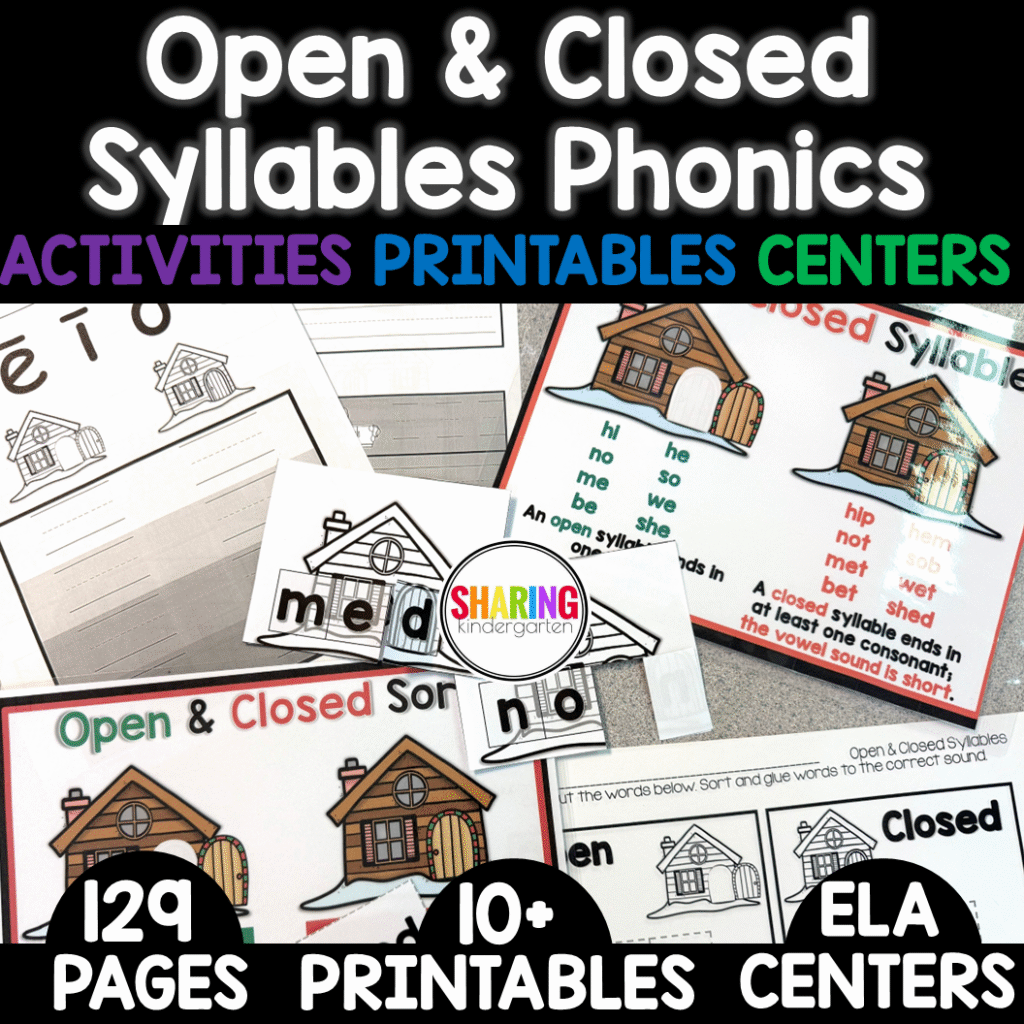
To help younger students master open and closed syllables, hands-on activities are key. This pack includes a variety of low-prep resources such as word cards, syllable markers, and open & closed syllable word sorting activities. These tools help students identify the type of syllable they are working with while building their ability to decode real words and multi-syllable words.
Examples of Activities Include:
- Sorting CVC words into open-syllable words and closed-syllable words.
- Hand gestures are used to show the end of the syllable, whether it’s open or closed.
- Identifying the consonant letters that close the syllable in closed syllable words.
- Blending individual syllables to read compound words and multisyllabic words.
Supporting the Science of Reading
This resource aligns with the Science of Reading and emphasizes explicit instruction in syllable types. Students learn how to analyze syllable patterns, identify single vowel sounds, and divide longer words into their syllable parts. By practicing with both real and nonsense words, students gain confidence in decoding and spelling unfamiliar words.
Why This Resource Is Perfect for Teachers
This open and closed syllables pack provides everything you need to support your phonics and spelling program. From vowel-r syllables to vowel team syllables, the included posters, charts, and printables ensure students develop a strong foundation in syllable conventions. These resources are perfect for whole-group instruction, small groups, and independent practice.
Ready to Teach Open and Closed Syllables?
If you’re ready to dive into teaching what are open and closed syllables, this resource pack is the perfect solution. It helps students master these important syllable types through hands-on, engaging activities that build phonological awareness and decoding skills. Whether you’re working with 1-syllable words, two-syllable words, or multi-syllable words, this pack has you covered.
Grab your pack today and watch your students thrive as they unlock the secrets of the English language, one syllable at a time!