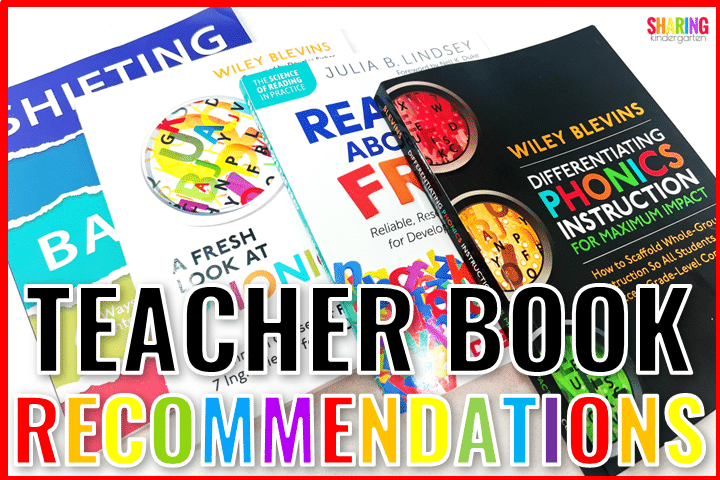
Teacher Book Recommendations: Science of Reading Books for PD: Expanding your classroom library with books based on the science of reading is an excellent way to support literacy development in young learners. The science of reading integrates insights from cognitive psychology, linguistics, and neuroscience to understand how children learn to read and the best practices for teaching reading. Here is a curated list of books published in the past year that can benefit lower elementary teachers looking to enhance their classroom libraries. So if you are looking for professional development books to add to your summer reading list it summer vacation reading, I hope you can find a new favorite book to help guide instruction for the upcoming school year. Here are some Teacher Book Recommendations to dive into.
Most teachers I know have a stack of books or resources they like to lean on when they have free time to help provide great opportunity for growth and change. I feel that these are mustread books for elementary teachers and books every teacher should read. So let’s get started with Teacher Book Recommendations: Science of Reading Books for PD.
1. “A Fresh Look at Phonics: Common Causes of Failure and 7 Ingredients for Success” by Wiley Blevins (2021)
Overview: Wiley Blevins’ book identifies common pitfalls in phonics instruction and provides practical solutions to overcome them. Blevins outlines seven key components for successful phonics teaching, making this book a must-have for any lower elementary teacher.
Why It’s Beneficial: Blevins is a leading expert in the field of phonics and reading instruction. His book is grounded in research and offers actionable advice, making it an essential resource for teachers committed to improving their phonics instruction.
My personal opinion: I found this great book to be an excellent opportunity to grab practical techniques to change teaching practices to become excellent in practice ways. I feel like this book tells you the top things NOT to do but how to change that routine or habit into a way to teach other skills successfully.
2. “Phonics from A to Z: A Practical Guide” by Wiley Blevins (2023)
Overview: This comprehensive guide covers everything teachers need to know about phonics instruction. It includes detailed explanations, lesson plans, and activities that support effective phonics teaching.
Why It’s Beneficial: “Phonics from A to Z” is a staple for teachers who want a thorough understanding of phonics and how to teach it. Blevins’ clear and practical approach makes this book an invaluable addition to any teacher’s library.
My personal opinion: This is one I have not personally read yet. I am a fan of Wiley Blevins in general so I have this title on my book list to tackle soon.
3. “Shifting the Balance: 6 Ways to Bring the Science of Reading into the Balanced Literacy Classroom” by Jan Burkins and Kari Yates (2021)
Overview: Burkins and Yates provide practical strategies for integrating the science of reading into a balanced literacy approach. They offer six specific shifts that teachers can make to improve reading instruction.
Why It’s Beneficial: This book is ideal for teachers looking to blend research-based reading practices with their existing balanced literacy frameworks, providing a practical guide to enhancing literacy instruction.
My personal opinion: This is another good book that I try to reread or look over every year or so to help guide my teaching skills with practical advice but also solid teaching advice. If your school or system is still using the Balance Literacy Approach, this is a must-read to provide practice ways to bring the science of reading into that approach. This is huge for teachers who are forced to used dated materials or practices in classrooms when the science of reading has proven better way to instruct the necessary skills learners need to have to become readers.
4. “Reading Above the Fray: Student-Centered Approaches to Whole-Class Instruction” by Julia Lindsey (2023)
Overview: Julia Lindsey focuses on student-centered approaches to reading instruction, providing strategies for whole-class teaching that meet diverse student needs.
Why It’s Beneficial: This book offers practical ways to elevate whole-class reading instruction, making it more inclusive and effective.
My personal opinion: I really enjoyed this book and recommend it to others. I found it easy to read and easy to implement.
5. “7 Mighty Moves: Research-Based Strategies for Improving Early Literacy” by Lyn Stone (2023)
Overview: Lyn Stone presents seven research-based strategies to enhance early literacy instruction. Each strategy is designed to be easily implemented and highly effective.
Why It’s Beneficial: Stone’s book provides straightforward, powerful strategies that can make a significant impact on early literacy development.
My personal opinion: I found this book to be a great book with an easy-to-read format. What a great way to gain info for decades of research in a compact way.
5. “Equipped for Reading Success: A Comprehensive, Step-by-Step Program for Developing Phonemic Awareness and Fluent Word Recognition” by David A. Kilpatrick (2016)
Overview: Kilpatrick’s book offers a step-by-step program for developing phonemic awareness and word recognition skills. It includes assessments, activities, and interventions that are aligned with the science of reading.
Why It’s Beneficial: This book provides practical tools that teachers can use to assess and improve their students’ phonemic awareness and word recognition, which are essential for reading success.
My personal opinion: This is another title I have heard rave reviews about and have on my list of must-grab book titles. I have heard this is a power book.
6. “Differentiating Phonics Instruction for Maximum Impact: How to Scaffold Whole-Group Instruction So All Students Can Access Grade-Level Content” by Wiley Blevins (2024)
Overview: Blevins offers innovative strategies for differentiating whole-class phonics instruction, ensuring that students at all skill levels can engage and progress.
Why It’s Beneficial: This book emphasizes differentiation, providing teachers with tools to make phonics instruction accessible and effective for all students.
My personal opinion: This is my book to read this summer for June 2024.
Additional Teacher Book Recommendations
I also want to dive into Dave Burgess Publications, as he has many great teacher professional development books. They have offerings for school leaders as well as teachers and everything in between. This could give you tools and great ideas over the summer months to make next year the best it can be. They have more titles than just books that cover Teacher Book Recommendations: Science of Reading Books for PD.
Professional Book Recommendations Conclusion
When looking at Teacher Book Recommendations: Science of Reading Books for PD, these book titles offer valuable insights and practical strategies grounded in the science of reading. So maybe this is a great time or the perfect time for you to grab a title that provides practical tips and the most effective ways to make instructional gains. By incorporating these titles into your classroom library, you can enhance your teaching practices and support the literacy development of your young learners. I can tell you from personal experience that the more you know, the better teacher you are.